Sunday, April 16, 2017

2017 NFL Draft Guide Preview

For those of you interested in the guide's content, here is a preview of two scouting reports and an article featured in the guide.


NAME: Deshaun Watson
HT: 6’2”  WT: 221
POS: QB
SCHOOL: Clemson
2016 Stats: 67%, 4,593 yards, 41 TDs and 17 INTs; 629 rushing yards and nine TDs
Career Stats: 67%, 10,168 yards, 90 TDs and 32 INTs; 1,934 rushing yards and 26 TDs
                     STRENGTHS

• Incredibly mechanically sound and consistent
• Fluid in his drops, staying in rhythm with the concept
• Shows the ability to zip the ball into tight windows on level one throws
• Drives his hips through the release point for added velocity
• Timing and rhythm passer who can throw guys open and keep them on their routes
• Developed pocket maneuverability, climbing and sliding with clean footwork while keeping his eyes down field
• Sound ability to reset his feet in the pocket, maintaining the connection with his eyes
• Heavy-handed ball comes out smoothly; adds desired touch on vertical shots
• Impeccable arm talent that will challenge the defense vertically
• Throws out-breaking routes and back shoulder fades to the requisite spots
• Scans the field and goes through progressions in a hurry
• Pocket poise allows him to remain accurate in a refined pocket
• Great athlete who can extend plays with his feet and deliver from an unbalanced base
• The moment never seems too big for him, stepping up and delivering as the game gets bigger
• Praised for his leadership and work in the community
• Graduated in three years and displays ideal maturity both on and off the field
• Will bird dog targets and lose his field vision, opting for tougher windows over easier throws
• Placement on in-breaking routes needs to become more consistent
• Inconsistent weight transfer and come-to-balance causes vertical throws to lose velocity on the back-end
• 2016 rise in interceptions were primarily a cause of his struggles to identify pre-snap disguises and rolls
• There were some occurrences of his front leg locking as he’s delivering, causing the ball to come out high
• Propensity to rush his feet as the pocket shrinks
• Shows over-striding when forced to really drive the ball
• Has escaped clean pockets, breaking the integrity of the play
• Lean lower-half and a slender frame with quite the mileage
• Bad habit of rushing anticipation throws that cause balls to scatter

POSITION TRAITS
TRAIT
RATING
SUMMARY
TRAIT
RATING
SUMMARY
Arm Talent

7.33
Strength/power: 6.5
Velocity: 7
Heavy ball: 9
Touch: 7
Accuracy at all levels: 6.5
Quick release: 8
Background/character
9.37
Leadership: 10
Experience: 10
Off-field: 10
Durability: 7.5

Mechanics
8.17
Base: 8
Stride: 7
Shelf placement: 9
Motion: 8.5
Drops: 8.5
Release: 8

Mental Game
7.08
Poise: 8.5
Vision: 6.5
Progressions: 7
Decision making: 6.5
Pre-snap reads/adjustments: 6
Under pressure: 8
Athleticism
6.9
Pocket work: 7
Scramble/run: 7.5
Make contested throws: 6.5
Accuracy on the run/move: 7
Complete off-platform throws/different arm angles: 6.5

Pro comp: Ryan Tannehill


Projection: Mid 1st Round
Total Score: 7.37
SUMMARY
Watson and Co. entered the 2016 with heightened expectations and it was evident in their first two games of the season in which they were pressing far too much (Watson included) in close wins against Auburn and Troy. Nevertheless, Watson and the Tigers quickly found their grove and rolled to a 12-1 regular season capped by their second-straight ACC Title. The junior quarterback posted another banner year by completing 67.6 percent of his passes for 3,914 yards and 37 touchdowns against 15 interceptions; he also added another 524 and six on the ground en route to his second straight Heisman Trophy nomination.

Much was made about Watson’s interception total this season, but I doubt it will deter scouts and it shouldn’t: while he has thrown two more than last season, Watson nearly matched his 2015 completion percentage (67.8) while throwing four fewer passes in two less games. Case in point, the Tiger have relied on Watson to beat teams through the air and should they make it to the National Championship, he will likely surpass 550 attempts. Watson possesses arguably the best mechanics in this year’s class, properly keeping the ball high on the shelf with his elbow more down than out to create a tight, over-the-top release while executing a six-inch step and the ability to drive his hips through the release point for extra zip and torque. He is also an intelligent player who has made the proper pre-snap reads based on leverage. What truly sets Watson apart is his performances when the lights are shining the brightest, particularly his National Championship appearances against Alabama as he has yet to appear rattled in his three seasons and was not fazed at any point in said appearances despite taking a beating. One little nugget that impressed me was a Triple In-Flood read that Watson missed in the Auburn game that he rectified later at the goal line against Louisville, resulting in a touchdown.
While Clemson featured many man and zone beaters and Hi-Lo concepts that required Watson to make the correct pre- and post-snap read, far too often did he stare his read down and elect to make a more difficult throw than what was required; while he flashed the ability to stare safeties down and manipulate them, he will need to do so with more regularity. As for those struggles on his verticals throws, Watson remained consistent when adjusting his shoulder plane for optimal trajectory but failed to put the requisite weight transfer behind such throws to put the ball out in front at times in 2016. He has displayed the ability to drop those throws in the bucket, but Mike Williams often bailed Watson out on those vertical throws with his leaping ability and strength at the catch point. Rushing his feet also caused Watson to misplace easy throws at the underneath level. He is certainly subject to myriad different draft grades and projections, but I believe Watson has the tools and mental ability to develop into a quality starting quarterback sooner than later.

There’s no doubt Watson was had in 2016 with what defenses threw at him pre-snap, something that overwhelmed him because of his underdeveloped field vision and awareness. His physical capabilities present serious upside and will undoubtedly translate well to the next level, but he will be tasked with making more full-field reads that will test his field vision and ability to go through his progressions in a hurry; however, they are correctable aspects along with his minor technical flaws and inconsistencies.


NAME: Myles Garrett
HT: 6’4”  WT: 273
POS: DE
SCHOOL: Texas A&M
2016 Stats: 33 tackles, 15 TFL, 8.5 sacks and two FF
Career Stats: 141 tackles, 47 TFL, 31 sacks and seven FF
                     STRENGTHS
WEAKNESSES
• Body-beautiful athlete with minimal body fat and noticeable muscles
• Off-the-charts athleticism with equal power
• Offers positional versatility having lined up as a 5 and 7-Tech and Wide 9
• Can squeeze inside and utilize his strong hands to shed blockers and locate the ball
• Strong rip move when slanting inside
• Rare quick twitch and lower-body flexibility
• Understands pad level and leverage; lower-body strength that halts down blocks and holds ground at the POA
• Combination of lightening quick first step and ability to run the arc before flattening his path
• Tremendous burst off the ball gets him on top of tackles in an instance and takes away angles
• Quick feet and active upper half allow him to work off and around
• Elite stride length after initial step to cover ground and beat tackles to the edge
• Refined ability to corner or fight to come underneath the arc if he ends up high
• Incredible closing burst, finishing with power
 Won’t consistently play with a sense of urgency in his run fits
 Inconsistent first step quickness; will try to guess rather than time the snap
• Lacks a consistent plan as a pass rusher, looking to win with strength and speed over layered moves
• Plays with reckless abandon, but needs to harness it; will rush too far up field and engage in taffy pull
 Needs to unlock explosive hip snap to leverage blockers to prevent being moved from his gap
 Knee injury limited him in the early portions of the 2016 campaign

POSITION TRAITS
TRAIT
RATING
SUMMARY
TRAIT
RATING
SUMMARY
Athleticism
8.75
Flexibility/bend: 8.5
Build: 9.5
COD: 8
Explosiveness: 9
Background/character
9.25
Leadership: 10
Experience: 9
Off-field: 10
Durability: 8

Intangibles
8.67
Motor: 7
Play-strength: 9
Tackling: 9.5
Aggressiveness: 8.5
First step: 9.5
Recognition: 8.5
Against the Run
8.08
Read-and-react: 8.5
Pursuit: 9
Gap integrity: 8
Stack-and-shed: 7.5
Range: 9
Set a hard edge: 6.5
Against the Pass
8.42
Hand usage: 8
Counter moves: 8
Refined moves: 7.5
Push the pocket: 9
Vs. double teams: 8.5
Speed rush: 9.5

Pro comp: Mario Williams


Projection: Top 5
Total Score: 8.48
SUMMARY

Garrett has some of the best genes in this year’s class. His mother, Audrey, was a 60-meter hurdles All-American at Hampton in 1982, his sister, Brea, captured the 2014 NCAA indoor championship in the weight throw as a junior at A&M, while brother Sean was a six-year NBA vet. Myles started as a true freshman where all he did was sack the quarterback 11.5 times as a Freshman All-American. Following that stellar campaign, Garrett popped, making 19.5 behind the line and racking up 12.5 sacks and five forced fumbles. He was named a first-team All-American in 2016 as he tallied 15 TFL and 8.5 sacks despite missing four starts.

Regardless of where he is eventually drafted, Garrett is far and away the best prospect in the 2017 draft class, and one of the best we’ve seen in quite some time. Humans aren’t built the way he is with the combination of power, strength, twitch and quickness that is bestowed upon him. What’s most impressive was how efficiently he blended those traits with his technique to create a truly dominant player. When scouting prospects, it’s important for the production to match the tape; if he’s dominating on the field, the stat line should be indicative of such-and it absolutely was with Garrett. What’s more, there was undeniable growth in his game from his freshman season until now, and he played through a nagging injury without compromising his production.

An incredible talent, Garrett is not without fault. He is unrefined in his run fits as he will stack and ride blocks late into the down, signaling his lack of urgency at times. Like most players with next-level strength and power, there are times where Garrett will look to win with said traits rather than his technique and pure moves. There’s a very strong possibility his loafs were a result of the knee injury, so there isn’t heavy emphasis placed on that aspect of his evaluation, but he will need to check his play speed at times to prevent washing himself out of plays.

His traits make it difficult to determine where he will play, but he is unquestionably athletic to the point that he doesn’t need to be pigeon-holed. The aforementioned quartet of base traits would certainly serve him well off the ball in the 3-4 or as a tilted Wide 9 in a 4-3; either way, defensive players with versatile skillsets are highly coveted in the NFL.


NFL Draft analysts are a fickle group when it comes to quarterbacks. As we inch ever so closely to the draft, the vast majority of us have eliminated the disconnect between our analyzation of this year’s top quarterback prospects.
There are no standardized rankings that we can pigeonhole these passers into, but such rankings are likely to feature Mitchell Trubisky, Patrick Mahomes, DeShone Kizer and Deshaun Watson. Each offer varied skillsets that will provide a seamless transition into specific systems, and I will break them down here.
Deshaun Watson
I start with Watson because he is my top-rated quarterback, and has been since before the draft process began. The opinions regarding Watson vary because of how tantalizing his evaluation is, performing like a top passer before some annoying aspects occur. Regardless, I’m willing to take his bad with the good because his peaks are higher than his valleys are low. The notion that Watson doesn’t read defenses is absurd considering the fact that NFL offenses feature man and zone beaters and full field reads that Clemson incorporated. However, Watson’s early playing time relative to where he’s drafted is important to consider if he’s a high first pick as those guys are seen as immediate plug-and-play players.
Case in point, he would be best suited to play in Hue Jackson’s system with the Cleveland Browns should they select him with the 12th pick and surround him with a deep threat in Corey Coleman, an X-receiver that can work at all three levels in Terrelle Pryor and an above-average tight end who can work in the red zone in Gary Barnidge.
Jackson is a great offensive mind who ties pre-snap shifts and motions into a multitude of different formations and personnel sets. While all passing offenses create one-two-three progression reads, they’re much easier to work through when you employ the variety Jackson does. The play design ultimately determines where the quarterback goes with the ball, and with a quarterback as intelligent as Watson, you’re able to stay on schedule and drastically mitigate the amount of bad decisions that can be had.
Patrick Mahomes
The Texas Tech quarterback is as polarizing as they come with the Air Raid stigma and never-ending, pressing issue of his mechanics hovering around his stock, but let’s discuss both. Contrary to belief, Air Raid concepts are commonplace in NFL passing games and don’t let anyone tell you differently; the issue with taking very little snaps under center is notable, but Air Raid coaches will tell you that their quarterbacks take countless snaps there during practice and are adept at doing such. Mahomes’ mechanics are certainly less than ideal and some aspects need tweaking (not necessarily overhaul), but it’s what works for him and has led to very few poor outcomes.
It remains to be seen what the New York Jets will do with their quarterback situation, but the Ryan Fitzpatrick experiment failed miserably and it’s clear that they don’t trust Geno Smith or Christian Hackenberg, so them sitting six and taking a quarterback is any level of feasible you can envision. Offensive coordinator Chan Gailey retired in January, leading to the hiring of Saints receiver’s coach John Morton. Both teams share identical systematic ideas — save for the Saints’ desire to stress the seams and the middle of the field — so expect to see quite a few of the same formations and sets.
Under Gailey in 2015, the Jets went four-wide roughly one-third of the time, the most in the league. The Saints’ system was predicated on unbalanced three-wide sets that created mismatches for their slot receivers on linebackers. When you spread a defense out as such, they have to account for this and spread simultaneously, making it far more difficult to disguise blitzes and coverage rolls. These widened throwing lanes become well-defined throwing lanes that forces quarterbacks to be aware of where they’re going pre-snap, an aspect of Mahomes’ game that he has showcased as an anticipatory thrower with good field vision.
Mitchell Trubisky
It may have taken him longer than he wished to see the field, but Trubisky waited patiently for two years before guiding the Tar Heels’ offense to eight wins. He has been the center of discussion during the draft and has been widely accepted as the class’ top quarterback, but he graded out as a high second-rounder for me who will be a quality starter in the NFL.
Much has been made about the San Francisco Niners snagging Trubisky with the second overall pick, and would prove to be a seamless transition. However, his most ideal fit would be with the Kansas City Chiefs. Quarterback isn’t their biggest need, but it is a need nonetheless as Alex Smith enters the third year of a hefty four-year, $68 million contract that will provide the Chiefs with a whopping $20.6 million cap hit in 2018. Smith will be 35 years old following the final season of his contract and news came out last month that the Chiefs are not interested in picking up Nick Foles’ option. General Manager John Dorsey has publicly shared his belief that this crop of quarterbacks is not ready to play or worthy of a top-10 pick. With that said, Trubisky is familiar with waiting for his chance, and it could be a perfect marriage.
Andy Reid runs a West Coast-based system predicated on being versatile and controlling the ball. Trubisky has a bigger arm and is a similar athlete, but the two still draw parallels and would allow Trubisky to thrive. This system incorporates a full route tree and a variety of formations that require quarterbacks to be concise and deliberate with their reads while featuring a bevy of underneath routes that create opportunities to generate offense, aspects Trubisky has mastered. Reid is a great play designer who can attack specific coverage, but over time Smith has struggled to target tight windows at the intermediate level with notable struggles maneuvering the pocket — issues unlike his potential successor. 

DeShone Kizer
Finally, we get to Kizer, the former Notre Dame passer who visibly regressed from 2015 to 2016. Kizer publicly admitted he lost confidence as a freshman, and likely suffered a lull in his abilities this past season when head coach Brian Kelly benched him for former starter Malik Zaire and criticized Kizer’s play following an embarrassing loss to Duke in which the signal caller threw for 381 yards and two touchdowns (against one interception) and lead the team with 60 rushing yards and another score on the ground. Kizer’s size will enamor most teams, but his regression and lack of confidence affected all aspects of his play.
Kizer’s big arm, ability to stay throw-ready, hang tough in pressure and read the whole field would be best suited in the Arizona Cardinals’ aerial attack that likes to stretch the field. Incumbent Carson Palmer completed 63 percent of his passes and threw for more than 4,000 yards in his first year in Arizona but also posted a 24:22 TD:INT ratio a year before tearing his ACL six games into the season. He came back strong in 2015, but took a leap back this past season. He recently signed a one-year extension with receiver Larry Fitzgerald which is a strong indicator that both will be calling it quits after this season. Behind the 37-year-old are Zac Dysert and Drew Stanton, average backups with very limited starting potential.
Because they love to go empty and threaten the defense with a bevy of options, quarterbacks in their system have to be prepared for five-on-five or defensive plus-ones, both aspects that support the defense’s desire to get to the quarterback. Kizer has done a good job recognizing these pre-snap looks and understands that he has to get the ball out in a hurry when pressure is bearing down; when he has more time, it doesn’t quite look the same. To help mitigate these concerns, Bruce Arians and Co. incorporate five- and seven-step drops off of play-action in which the running back will stay in to protect while Palmer’s 10.8 yards per attempt off of PA in 2015 ranked second in the NFL.
The system is essentially an Air Coryell-based system that features intermediate-deep attacks with backside options that manipulate the one-on-one matchups the heavy reliance of 3×1 sets manufactures, while going empty gives the defense four to play five. Quarterbacks have to be adept at working through the progressions and understand that the majority of the deep shots are naturally going to come off of play action. It would serve Kizer well to sit behind Palmer for a year and learn the nuances of the system, while Mahomes could certainly be in play at pick 13 if they don’t wish to spend a second rounder on the Fighting Irish quarterback.

The 2017 NFL Draft Guide is complete! Over 300 draft prospects and 600 pages of detailed, in-depth information regarding all rounds, team needs and player profiles of the 2017 NFL Draft. It is one of the most comprehensive draft guides available with over eight months of detailed analysis. You will not be disappointed with the quantity, and quality, of information. Use the purple "Buy it now" tab in the right column to get yours today!

Saturday, August 20, 2016

Winston Well Worth the Hype

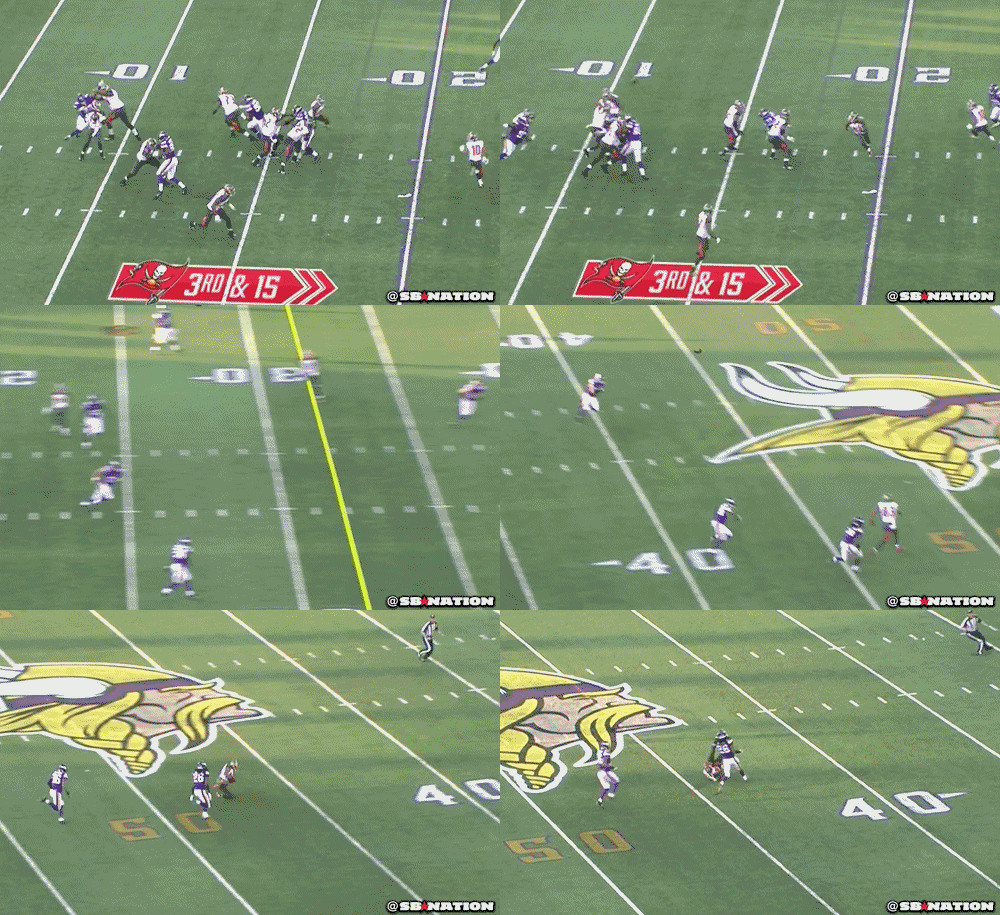
Rookie quarterbacks affect coaching and game plan as much as anything, and being the first overall pick comes with a heavy burden of expectations. Coaches are forced to dedicate precious amounts of time to developing these young passers, while protections and progressions are simplified to make the transition easier. Winston wasn't asked to set the line pre-snap very often, but he was one of the more cerebral passers in the 2015 draft class coming from Jimbo Fisher's system that asked him to utilize his mind before and after the snap; Winston's mind was simply advanced. Here, I will break down Winston's traits that made him a number one overall pick with weak aspects in his game that need development.


I begin with these three videos because they showcase anticipation consistencies in my evaluation during his time at Florida State. Anticipation is one of the most vital aspects quarterbacks possess because everything is happening at a much quicker pace at the next level, and if you have an underdeveloped ability to throw guys open or hit windows as they're opening, your NFL days are numbered.  We begin with his first NFL game, a preseason matchup against the Vikings. It's not visible, but Winston releases the ball just before Mike Evans' break on his post route and puts the ball out in front. The next video features Evans again against the Redskins and Winston's five-step drop, keeping his eyes on the single-high safety to manipulate the defender. Following his hitch, Winston drops an ideally-placed ball where only Evans can get it, but you should notice that the corner actually has a step on Evans as the ball travels; Winston anticipated Evans' stride length to stack that corner and haul in an easy six. Finally, you get a clearer view of Winston's clunky, elongated motion that will allow corners with twitch to break on throws that take longer to arrive. Regardless, Winston holds a stronger lower-half that propels him through sacks and adds velocity and rotation to his intermediate throws. That part of his body is evident in the third video against the Saints, coupled with the continuous theme of anticipation: Winston recognizes Brandon Browner (#39) run with the underneath route and immediately throws a strike to open window behind him.


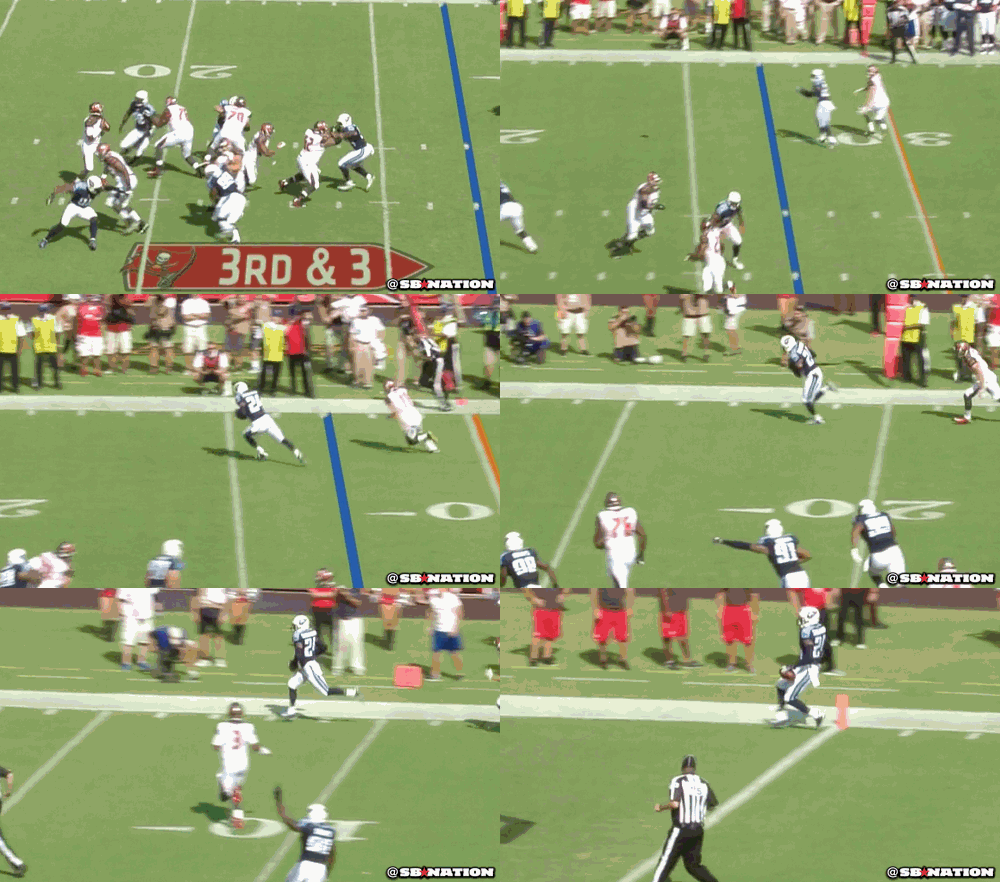
For all the promise Winston showed, he wasn't immune to looking like a rookie. Beginning with the first video, something I noticed in Winston's FSU evaluation was his in ability to get the necessary weight transfer on every throw. Not stepping into your throws is detrimental to the ability to squeeze the ball into tight windows at all levels of the field, a trait on display in the first video as the ball comes too far infield; throwing the ball late like Winston did doesn't aid his cause
either, while the poor weight transfer occurred on a number of throws last year. The next video against the Brown exposes Winston's youth, and doesn't require much explanation: throwing late across the middle is a cardinal sin as far down as Pop Warner. The final video focuses on a lapse in decision making that I also noticed in his evaluation. It's difficult to confirm, but I believe this throw was predetermined due to the fact that he released it at the top of his drop; if it was, you can chalk that decision up to inexperience. Regardless, he should have known the degree of difficulty that throw possesses and chosen to go else where or get rid of it.

The rookie threw for 4,042 yards and 22 touchdowns against 15 interceptions, adding another 213 and six on the ground. Winston's 58.3 completion percentage isn't something to fret over as he still has developing to do like all rookie passers. He certainly showed flashes of a star to come.

Tuesday, August 16, 2016

Gronk on Pace to Become NFL's Best Tight End- Ever

Rob Gronkowski is not your typical tight end. Coming out of Arizona, the New York native measured as one of the 2010 draft class' biggest at such position at 6'6," 258 pounds. His 4.68 40 ranked in the 75th percentile, while his 10 yard split ranked in the 85th. Gronk parlayed his successful combine and accomplished college career (third team All-American as a sophomore despite missing the first three games) into a second round pick by the New England Patriots. Had he not missed his entire junior season due to injury, there's little reason to believe he wouldn't have gone in the first.

The Patriots utilized him as a rookie, starting him in 11 games where he recorded 42 receptions for 546 yards and 10 touchdowns; his three touchdowns as a rookie were the most by a rookie in franchise history as the youngest player in NFL history to do so. Gronk exploded onto the scene the following year, snagging 90 balls for 1,327 yards and 17 touchdowns, the latter two of which were NFL records for tight ends- in only his second season. Through his first six seasons, Gronk has tallied 380 receptions for 5,555 yards and 65 touchdowns and has a career similar to that of Jason Witten, Tony Gonzalez, and Mike Ditka via Pro Football Reference.


As tough a runner Jason Witten was, Gronk matches such physicality but possesses unmatched athleticism and ability to make defenders miss in the open field. His play speed, fluid feet, and balance allow the Patriots to flex him out in slot or as a single receiver which is the crux of what makes Gronk one of the most valuable players in the league: he's bigger than the linebackers tasked with covering him and has the speed to challenge safeties down the field. These two videos are prime examples of why the Pats love getting the ball to him in space and running route combinations, lining him up in bunch sets, that allow him a free release so Tom Brady can quickly get him the ball; since 2011, New England has reduced the average time before attempt each season, while averaging between eight and nine yards per attempt. This quick-strike system is why the likes of Wes Welker and Julian Edelman-relatively unwanted slot options prior to their Patriot careers- have thrived in New England.


The first video touches on the aforementioned versatility that allows him to thrive in the slot and challenge safeties, but also highlights Gronk's route running, an aspect he has improved since his rookie season. He sinks his hips and accelerates out of his break to create separation at the top of his route before making a clean catch and hanging on over the middle. The second video showcases the Patriots' four tight end package in the red zone, an aspect of their passing their game they utilize frequently to beat man coverage use as extra blockers in their run game; Scott Chandler was an ideal player in that package and Martellus Bennet will thrive in the red zone in 2016. Here, Gronk uses his well-documented athleticism to dip underneath and stack his man defender before making a catch that corner back's can't defend.


Tight ends are tasked to play an important role in the running game, and Gronk's blocking ability is arguably the best in the league. The video's captions highlights his sound technique, but his strength and size make him a difficult task for defensive ends to beat.


The NFL's elite have very little holes in their game and players at this level have high football IQs that can mask whatever weaknesses they may possess. Nonetheless, Gronk is not a perfect player. One area where he can reduce his inconsistencies his is inability to disengage from physical defenders, failing to use his hands to combat such weakness. Another recurring inconsistency is getting into his break: being the explosive athlete that he is, he should be able to get in and out of breaks with ease rivaling that of NFL receivers; the second video shows that isn't necessarily the case.

Above all else, perhaps Gronk's biggest weakness is his injury history. He missed five games in 2012 due to a forearm injury before undergoing surgery to fix the issue in May 2013; he also underwent back surgery in June of that same year. The 2013 season robbed him of nine games as well due to MCL and ACL tears, returning to form in 2014 with 82 receptions for 1,124 yards and 12 touchdowns in 15 games (10 starts).

Tony Gonzalez is statistically the best tight end the NFL has ever seen, and Gronk may not touch his career records. I don't believe that's indicative of Gonzalez simply being the better tight end: Gonzalez's records are durational-he played for 16 years, a number Gronk may not see due to his injury troubles. Cross-era comparisons hard to support and defend, but when it's all said and done, we can make the definitive case for Gronk as the game's most talented tight end.


Thursday, August 11, 2016

Mathieu Deserving of Contract if he Remains Healthy

Growing up in New Orleans, former home-state and current Arizona Cardinal star Tyrann Mathieu has witnessed his fair share of obstacles. The city's poverty rate of 27.7 in 2015 found its spot amongst the 10 most poverty-stricken cities in America, while its murder rate of 46 (per 100,000) ranked second. Here's this excerpt from a May 2016 Times-Picayune article:

"Harper suggested Louisiana's high rate of incarceration – the highest in the world – plays a significant role in New Orleans murder rate. In 2013, 847 out of every 100,000 adults in Louisiana were locked up, compared to 353 in California, according to the U.S. Department of Justice."

Mathieu can relate: his father, Darrin, was brought up on murder chargers and has since been incinerated for the majority of his life. His mother remained absent during his upbringing as well, leaving his guidance in the hands of his grandparents; following the passing of his grandfather, Mathieu was adopted by his aunt and uncle, Shiela and Tyrone Mathieu.

Undeterred by his domestic issues, Mathieu became a four star recruit at New Orleans power St. Augustine, the home of current LSU Tiger phenom Leonard Fournette and the seventh most NFL players ever

He chose to stay close to home as apart of Les Miles' Tigers where he quickly became a star. As a true freshman in 2010, Mathieu played in all 13 games and finished the season with 59 tackles, three sacks, and two interceptions, earning Cotton Bowl MVP honors along the way. The following year was Mathieu's coming out party that began with a stellar performance against the Oregon Ducks that saw him tally 10 tackles and a forced fumble that he proceeded to recover and run in for six. The remainder of the season was a cake-walk for the sophomore who paced the team with 76 tackles while registering 7.5 tackles for loss (fourth on the team), 1.5 sacks, two interceptions, six forced fumbles, and five fumble recoveries. He made an impact on special teams as well, returning 26 punts for 420 yards and two touchdowns as an integral part of LSU's National Championship team; he garnered the Chuck Bednarik Award and first team All-American honors for his efforts. Mathieu has a seasons worth of highlights rivaling that of most players' careers.

That stellar season also featured the Heisman Trophy finalists' one-game suspension for a violation of the program's drug policy. This would ultimately serve as a precursor for a much larger issue: on August 10, 2012, Miles announced that Mathieu would be dismissed from the program for a violation of team rules (the media believed the cause was multiple failed drug tests, although Miles did not confirm such speculation). He withdrew from the school a week later and entered a drug rehibilitaion before enrolling in fall classes the following month. Mathieu's issues compounded when he and three other LSU former players were arrested on possession of marijuana on October 25th. He would declare for the 2013 NFL Draft and accept an invite to the combine where he posted a 4.5 40, 34 inch vert, and a 9'7" broad jump en route to a third round selection by the Cardinals.


Mathieu developed into a impact rookie, spending time as a slot corner and free safety (11 starts) as he racked up 65 tackles, one sack, one forced fumble, and two interceptions as a first team All-Pro; he truly lived up to the Honey Badger moniker he earned as a sophomore. His successes are attributed to his elite instincts and athleticism that made him such a dynamic player at LSU, but what truly set him apart were his route recognition and fluidity. He does a good job of reading the route combination and adjusting in man, using his fluid hips and IQ to match the receiver's route. From there, he appropriately gets his head around and adjusts to the ball to complete the interception. Mathieu's superb rookie campaign was cut short after 13 games due to ACL and LCL tears in his left knee.


The first video represents the aforementioned instincts and athleticism. He gets downhill to attack the ball carrier who does a fine job of reading his open-field block and recognizing the open lane to the left. Mathieu instinctively witnesses the open path, spinning to avoid the blocker and using said athleticism to snap into a balanced tackle attempt. A defender's burst is a key trait that allows them to make plays fewer guys can; Mathieu is such player. In the second video, you'll notice his burst off the edge and hustle to get down the line and make plays in the backfield that mirror those he made as a Tiger.


2014 was something of a recovery year for Mathieu-as indicated by his stat line-while 2015 was a culmination of health and elevated play. The Cardinals' defensive scheme is characterized as a man-match zone scheme that offers complexities for the linebackers and safeties, Mathieu's position in their base defense with a role as a slot corner in their nickel package. Defensive coordinator James Bettcher prefers this system because it isolates fellow corner Patrick Peterson on opponents' top targets where he can win one-on-one matchups. Bettcher also (wisely) prefers to run lots of man with his elite athletes in the defensive backfield, shown above in Cover 0. Mathieu reads his man accurately and works downhill, jumping the route and taking the interception to the end zone.


It's difficult to find major flaws in Mathieu's game, but flaws exist nonetheless. He plays with a generally tall backpedal that doesn't cause the same problems it would with lesser athletes, although it does cause him to hitch at the top of his click-and-close; you'll notice this issue in the first video. Being an aggressive player results in momentum-shifting plays on both ends of the spectrum, creating a classic conundrum for such players. The second video is a prime example of such where Mathieu bites on the double move, and has done so multiple times throughout his career including on play action. Much like the issue with his backpedal, his aggressiveness doesn't affect him the same way it would most players: Mathieu's recovery ability and intelligence allow him to be the aggressor he is without them becoming recurring issues.

Mathieu was well on his way to Defensive MVP honors this past season before tearing his right ACL in Week 15. Regardless, he finished with 89 tackles (third on the team), one sack, one forced fumble, five interceptions, and 12 pass breakups and parlayed his first team All-Pro season into a brand new, 5 year/$62.5 million contract extension. He finished as Pro Football Focus' top rated corner after allowing a mere 77.6 quarterback rating, but $40 million guaranteed is a hefty price tag for a player who simply won't have quite the same agility and quick twitch fiber after major surgeries on both knees.

Despite the questions surrounding the contract, Mathieu is more than deserving of wearing the "highest paid safety" label. He has proven to be a first-class citizen who suffered an embarrassing fall from grace only to accept responsibility and earn all that he has as a loving father who cares deeply about his hometown and the Cardinal organization for simply giving him a chance. On the field, he is deeply admired and respected by his teammates due to his endearing leadership qualities. Reports have Mathieu's expectations to return sometime next week, a huge sigh of relief if they hold true. Whether or not the timetable holds true, it's exceedingly difficult not to root for Tyrann Mathieu. 

Wednesday, August 3, 2016

With More Weapons, Carr Primed for Big Year

The turn of the century has not been kind to the Oakland Raiders. After posting a 33-15 record with three AFC West titles and a Super Bowl appearance during the first three seasons of said century, they have yet to reach the playoffs or post a winning record. What's more, they've gone through nine different head coaches and a whopping 18 quarterbacks since 2000; this stretch of futility is the result of the late Al Davis' substandard first round draft choices of the likes of Robert Gallery, Fabian Washington, Darrius Heyward-Bey, Tyler Brayton and JaMarcus Russell. One poor draft can substantially set a franchise back, but multiple can cripple a franchise for years.

Enter quarterback Derek Carr, the third year passer from Fresno State who measures at 6'3," 218 pounds with impeccable arm talent. Prior to his stint as a Bulldog, Carr rewrote the Central Section record books at Bakersfield Christian at the helm of CIF Division V champions. Following the completion of his senior season in 2009, he was named the National Player of the Year by the National Private Schools Athletic Association.

From there, all Carr did was rewrite Fresno State's record book previously littered with marks held by his older brother, David; Derek would finish with 12,843 yards and 113 touchdowns through the air against a meager 24 interceptions. He garnered first round buzz as the 2013 season progressed, but "questions" regarding how the family's lineage would prove impactful for his future with the Houston Texans, who held the number one pick, surfaced just weeks prior to the draft (David was taken number one overall by the Texans in 2002, but failed to live up to the billing albeit being in a terrible situation). Following a disappointing performance against USC in the Las Vegas Bowl, more questions persisted regarding his ability to handle next-level competition.

The Raiders took a flier on him in the second round and never looked back: after briefly battling with Matt Schaub, head coach Dennis Allen named Carr the starting quarterback for the 2014 season. He flashed signs of brilliance as a rookie, throwing for 3,270 yards and 21 touchdowns while managing to take care of the ball (12 interceptions) behind an underwhelming offensive line with an equally underwhelming supporting cast. Perhaps the most eye-popping stat were his 599 attempts, the second most by a rookie in NFL history, coupled with the fact he was able to keep his rookie mistakes to the bare minimum. Regardless, it's extremely difficult to win games when you ask your rookie quarterback to throw the ball 37 times a game, and the Raiders 3-13 record was a direct reflection of such sentiment.

This past season proved to be far more exciting for Raider Nation with the additions of receivers Michael Crabtree and Amari Cooper and the growth of running back Latavius Murray, providing Carr with the necessary weapons. Cooper became the first Raiders receiver to exceed the century mark in an NFL-most 11 seasons, while Murray tallied that same number on the ground as the first Raider to do so since 2010. In turn, Carr's numbers rose to 3,987 yards and 32 touchdowns against 13 interceptions despite 26 fewer attempts. His 53 touchdowns through his first two seasons rank second in NFL history.


When you turn on Carr's film as a rookie, you wouldn't know he was one: his play showed very little indication of a rookie quarterback behind center while it was evident he elevated those around him. This video showcases the anticipation and aforementioned arm talent Carr possesses; he is rolling right when he recognizes his receiver getting to the top out of his route. Carr knows this receiver now has the leverage and throws it at the ideal time with some serious zip that creates tight spirals at all levels of the field.

carr 3 gif

This play is one of my favorites and comes from his 2014 preseason start against the defending champion Seahawks who Carr shredded (against their starters mind you) for 143 yards and three touchdowns and zero interceptions on 11-for-13 passing. This touchdown encompasses a multitude of areas where Carr excels. After setting up off of play action, Carr manipulates the single-high safety with his eyes, holding him there just long enough to eliminate him making a play on the ball; although Carr has struggled with bird dogging his the target the past two seasons, he's shown progress in that field. He recognizes he doesn't like the read post-snap so he steps up in the pocket, resets his feet and delivers a beautifully thrown ball by elevating his shoulder plane and and climbing his plant leg for optimum trajectory. Granted the receiver has a three yard cushion on the defensive back, but dropping the ball in the bucket as such is imperative when that cushion is reduced to inches.


The first video came from his career start against a talented Jets defense. For starters, Carr is a student of the game who can quickly recognize coverages and rotations, doing so here by seeing the Jets bring pressure off the edge with Cover 1 behind it. He sees this pre-snap and knows he's going to throw hot and take what the defense gives him, which in turn allows hims weapons to work with the ball. Carr puts the ball in a good spot and keeps his receiver on his route for an easy six. As for the second, you'll notice Carr's deep anticipation and ability to throw to a spot that Chargers' defensive back Jason Verrett has little chance of disrupting. The anticipation comes into play as the Chargers roll to a Cover 1 Robber look, forcing the free safety to play center fielder. Carr holds him there before releasing the ball just as his receiver gains leverage on Verrett; too early and the safety makes a play on the ball, but too late and you deviate from attacking the proper single-high window.

While Carr has grown over the last two seasons, there are still glaring deficiencies in his game. Through Week 13 of the 2015 season, seven of Carr's then-nine interceptions had come in the fourth quarter while six came when the Raiders were trailing by only a score. Those are attributed to the bird dogging I previously mentioned, but he is not immune to the forced throw or slow mental clock; he is a great athlete who can get outside the pocket and extend plays with his feet, but there have been multiple occurrences of him holding the ball longer than the route concepts suggest. In that same time period, Carr also posted a lowly fourth quarter passer rating of 55.6

He is a young passer who is still mastering his craft and will likely cut down on the mental mistakes in year three. The Raiders offense is fun to watch due to offensive Bill Musgrave's use of multiple formations and personnel groupings that feature Carr both under center and in the gun. His play calling was rather predictable in 2014 and defenses capitalized on that, but with Murray's growth on the ground and through the air, Musgrave presented the opposition with more challenges. Oakland overhauled their offensive front and quite possibly boast the second unit of any team not named the Dallas Cowboys. I also expect the Raiders to give tight end Clive Walford an increased workload after his improvements in 2015. All points back to Carr, who should take that imperative Year Three leap.

Tuesday, August 2, 2016

Ryan Tannehill Has Top Quarterback Potential

Miami Dolphins quarterback Ryan Tannehill is a definitive candidate for NFL players who are just scratching the surface of their potential. A former receiver, Tannehill was originally recruited to Texas A&M to play quarterback before being beaten out by Jerrod Johnson and veteran Stephen McGee as a redshirt freshman. Head coach Mike Sherman quickly realized the athlete he had in Tannehill and made the decision to move him to receiver where he hauled in 46 receptions for 609 yards and four touchdowns in 2009 as approximately 80 percent of his receptions went for first downs or touchdowns; he earned honorable mention All-Big 12 honors for his efforts. He split time with Johnson the following season, starting seven games and completing 65 percent of his passes for 1,638 yards and 13 touchdowns against six interceptions while adding another 76 and one on the ground. He was recognized as an honorable mention all-conference selection for the second straight year.

2011 was Tannehill's breakout year as he earned the starting nod and ran with it: he completed 61 percent of his passes for 3,744 yards and 29 touchdowns (15 interceptions) while adding another 306 and four on the ground. He capped his illustrious seasons by guiding the Aggies to a bowl victory over Northwestern before declaring for the draft. Tannehill's exceptional pro day performance, where he measured at 6'4," 217 pounds with a 4.58 40, catapulted him into top 10 conversation that the Dolphins capitalized on; they took him eighth overall.

The 17th Dolphins starter since Dan Marino took his bumps as a rookie and showcased his deep ball struggles that plagued him at A&M.

Miami Dolphins 2012-2013 highlights

The video above features a multitude of things. For starters, you'll notice Tannehill's ability to step up into a clean pocket, reset his feet, and deliver the ball down the field, creating pocket awareness and maneuverability he flashed as a rookie and has bettered has his career's progressed. Things go awry from there where the aforementioned deep ball issues rear their ugly heads. Although his accuracy is on display here, albeit something he still struggles with today, his lack of touch is what potentially costs Brian Hartline six.


Because Tannehill is a change-of-pace passer, those issues with down field touch are not uncommon. This video highlights the quick release and zip Tannehill possesses, zip that challenges defenses at all levels of the field as a trait he perfected at A&M and is comparable to top NFL quarterbacks. These attributes served him well last year where the Dolphins featured many vertical route combinations out of 2x2 and 3x1 sets that dove the defense deep before an underneath route came open late and allowed them to get their athletic pass catchers out in space and earn yards after the catch; the same can be said for their heavy use of bubbles and spot screens. Case in point, Tannehill's arm talent is top tier.


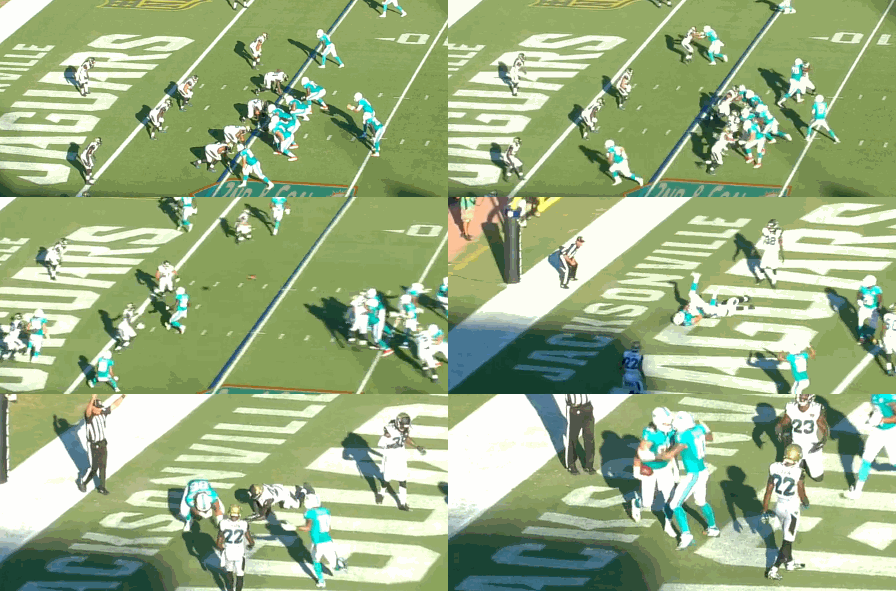
This is one of my favorites because it encompasses many areas where Tannehill has really grown. There has been an exponential growth in his football IQ as he has made the correct pre- and post-snap reads on countless occasions and has grown to understand throwing lanes. In turn, hwill take what the coverage frees up, allowing him to create offense. Jacksonville's defender is lined up slightly outside shade of tight end Jake Stoneburner, something Tannehill recognizes pre-snap and realizes Stoneburner has the leverage. From there, he keeps his footwork in rhythm with the concept and anticipates him running into the window behind linebacker Telvin Smith and delivers an absolute strike with impeccable timing.


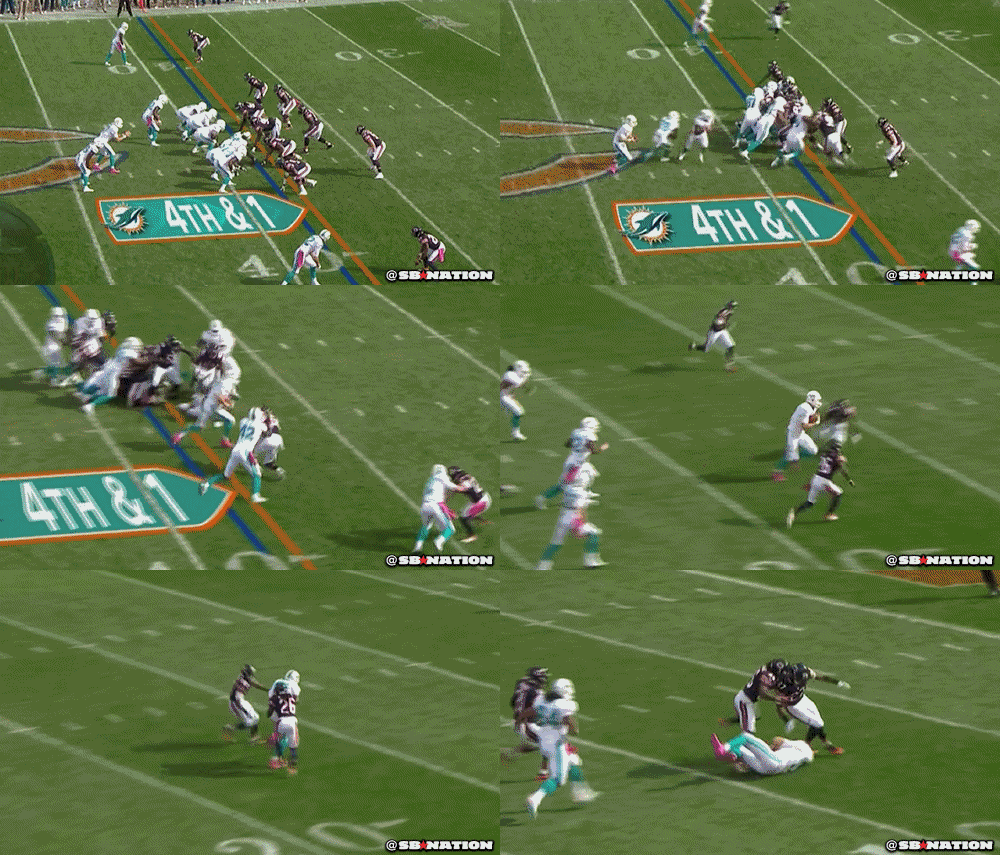
Pointing back to Tannehill's 40 time and numbers on the ground at A&M, this video is an example of the dual threat ability Tannehill brings to the table. With 911 career rushing yards and five touchdowns, he can extend plays with his feet and poses a threat when he escapes the pocket.

While Tannehill is growing as a player, his mental processing continues to be a glitch in said growth. Many times last year, Tannehill had guys open in tight coverage and he failed to pull the trigger while the opposite was also true, and he held on to the ball waiting for someone to get open, a cardinal sin in the NFL.

Regardless, he's bested his numbers each season, a remarkable feat considering he was forced to begin his career with the likes of Mike Wallace (long removed from the former Steeler version), Brian Hartline, and Reggie Bush. Tannehill has posted back-to-back 4,000 yard, 24 touchdown seasons, but has fumbled the ball a staggering 38 times and tossed 54 interceptions in his four seasons. If Tannehill wishes to be the next $100 million passer, he drastically needs to cut down on the turnovers and improve his undesirable 29-35 record as a starter.

The 2016 season offers serious hope for Dolphins fans with new head coach Adam Gase. Continuity is absolutely key for young passers, and with three offensive coordinators in four years, it's a feat that hasn't stunted Tannehill's growth, a testament to his mental and physical capabilities. The Dolphins' line was absolutely gashed by the blitz last season and it lead to Tannehill taking a beating, but Gase brings a quick-timing system predicated on three-step drops and immediate decision making. Thus, an elite pass blocking offensive line isn't a necessity and makes the Laremy Tunsil decision more of a head scratcher.

2015 first round selection DeVante Parker battled a foot injury for most of last season and struggled to see targets behind a talent receiving corps, so look for him to become the team's number two option with Greg Jennings and Rishard Matthews now gone. Recent reports have Arian Foster taking first team reps, a plus both on the ground and in the air, but adding Kenyan Drake was quite possibly their best move in the draft. He works best in space and was used heavily as a receiver at Alabama, in addition to his impact on the ground that should translate well to the next level. With the litany of weapons at his disposal, expect Tannehill to capitalize on his potential.